Showing posts with label Monarch. Show all posts

Monday, October 13, 2014

HOW TO HOLD A MONARCH BUTTERFLY

So lets just say for a minute that you have caught a Monarch butterfly, and you don't know how to hold    
it.
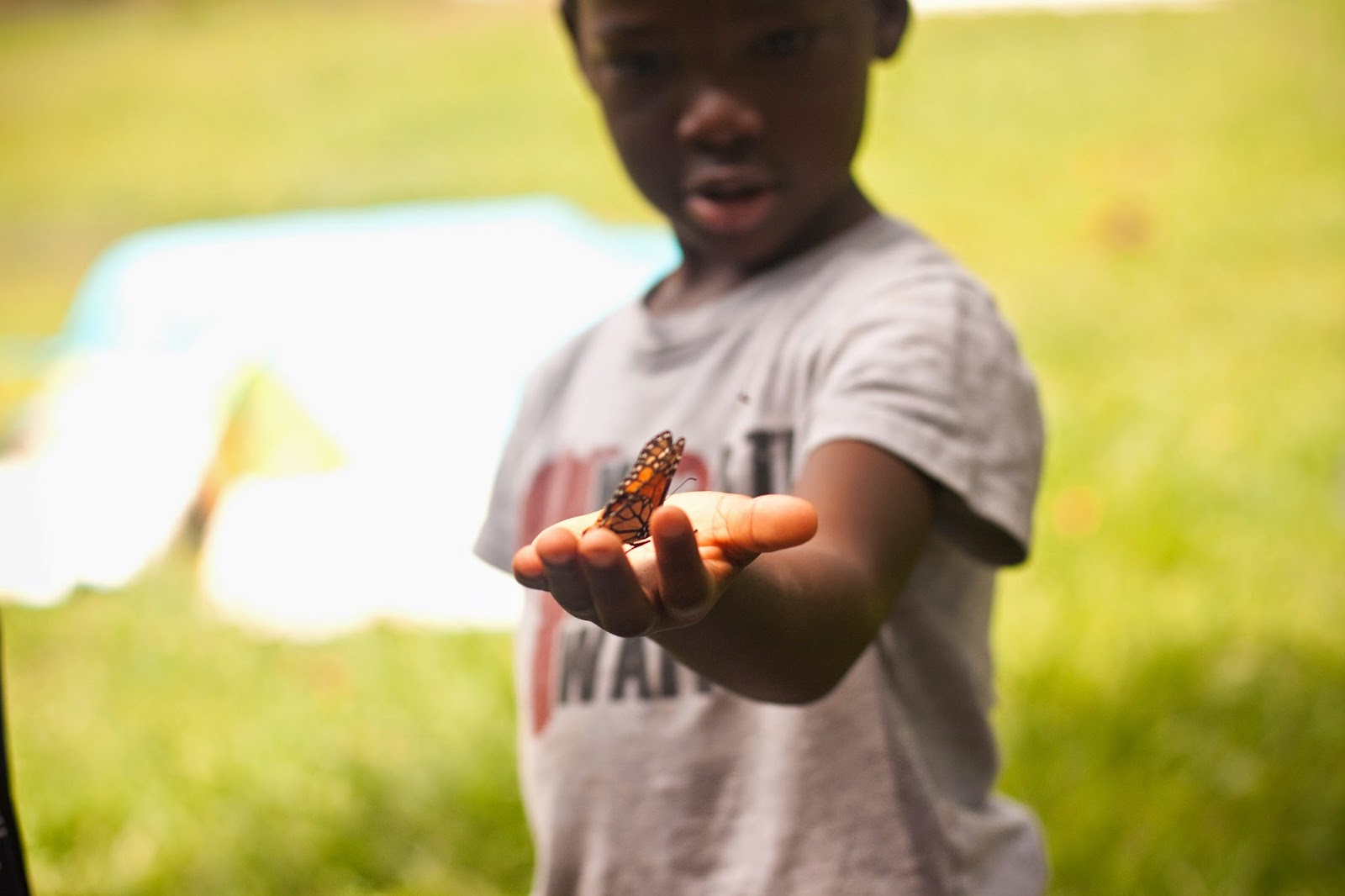
It's very simple. First take your index and second finger and gently grasp the upper part of the wings, as  
shown above.
 Secondly and last, you use the same two fingers on the other hand and grasp the first four legs (the other two are usually under the wings along with the abdomen). You can only hold butterflies like this that are in the brush-footed family because they have much stronger legs and wings. This is pretty much 
all that you need to know on how to hold a Monarch butterfly.

POST BY ETHAN


Monday, October 6, 2014

OUR LONE SURVIVOR

The Monarch is definitely the most amazing (and beautiful) butterfly in North America. They are very easy to raise, so, we did.                                                                                                                                    All you need is:                                                                                                                      
  • A non-air tight container with holes in top to make sure that the caterpillars have plenty of air.
  • A poop catcher (I used a sheet of paper, you really need this because they poop a whole lot).
  • Milkweed (the caterpillars will only eat plants that are in this family).
  • Something for them to pupate on, such as a twig or they may rather use the lid of the container.


I went into a field to catch Monarchs to tag, but instead I found something better, a huge Monarch caterpillar! I plucked him and his plant, and I went out to see if I could find any more. This I did and succeeded, I found about 6. 


I took them inside and put them in my container with the poop-catcher (paper) in the bottom. I provided them with fresh milkweed when needed. They munched and munched  and grew and grew until most of them were huge. However only one of them lived, the lone survivor.

          One way to keep your milkweed fresh is to put it in a zip-lock baggy and refrigerate.

Welp, our caterpillar grew to pupation point, and this he did. He hung from a pair of claspers at the end of his body (ours chose the ceiling to hang from) and turned green and wrinkly (He had not fully developed his cocoon just yet). We found the shriveled skin underneath the cocoon.


Here it is fully devoloped.

 Finally it went from this... 

 all the way to this!!!

 You could actually see the wings and abdomen developing inside of that tiny little chrysalis.

 The very morning after it turned blue, we all of the sudden found this! We tagged and released our little lone survivor, and as soon as he was out of our hands, he started on his long, hard journey South.


POST BY ETHAN

Wednesday, September 17, 2014

MONARCH TAGGING


I am loving having a Monarch tagging kit. I think that the best part of it is holding these amazing insects.

                                 Click here to purchase a Monarch Tagging Kit. 
Monarch tagging is just one of the ways that we can help this amazing butterfly. Each tag has its own unique number and letter code that you write down on your data sheet, along with gender, date, and place of capture. 

 By placing this tiny tag on the Monarchs wing, we can figure out what route they are taking, how many stops they make on the way and how long they stay there. By "on the way",  I am talking about their  amazing migration from Canada to central Mexico and back.

Image Source
The Monarch pictured above is a male, and the way you can tell is, on both hind wings there is a little sack and his veins are thinner then a females.

                                                     This is how you hold a monarch.
                                                           This is a Monarch that we tagged.

                                                                  Moses released it.


They are one beautiful butterfly that I would like to  try to help keep alive. 
Tagging is one of the ways that we can help, but another is planting butterfly gardens. For this specific species you only need to plant milkweed which serves as a dual-purpose plant, being food for both adult and larvae. By doing these two little things, we might be able to save these beautiful butterfly.


This is a Monarch Caterpillar on a Milkweed plant.